

The Obstacle IS the Path
Facing the comfort crisis and learning how to live an aligned life

Click to listen:
“The obstacle is the path” is one of those Zen sayings we nod at and move past. Just like the way we respond “fine” when someone asks how we are. It’s reflexive.
But what happens when we really contemplate what this saying means, and then begin to live it?
Our world expands.
The Comfort Trap
We hate discomfort, and of course we do! Our nervous systems are built to move us away from pain and toward safety. But somewhere along the way, avoiding discomfort became all consuming: binging Netflix, endless scrolling, shopping for things we don’t need, a drink to take the edge off. In small doses, this is just being human. In large enough doses, they become a strategy to keep the discomfort out at all costs, but that has a cost of it’s own.
Comfort-seeking has become a crisis of its own making.
There's a clinical name for this. Acceptance and Commitment Therapy calls it experiential avoidance, a life organized around dodging uncomfortable internal states. Decades of research on it point to the same thing this essay is built on: avoidance doesn't just fail to solve the discomfort. It's the mechanism that makes a life smaller.
Because as we run from discomfort, our world shrinks.
We stop trying the new thing because the risk of failing is too scary. We hide our dreams deep inside in a place we fear to look because our day-to-day reality doesn’t make it easy. We build smaller and smaller boxes to live in, and we call it self-care or realism or just being tired. That’s all true… to a point. But a life organized around avoiding discomfort doesn’t actually get more comfortable.
It gets more brittle and we become less able to withstand anything at all.

The Obstacle that Changed My Life… For the Better
Healing moves us in the opposite direction. In order to heal we must face the pain.
When we lean into discomfort instead of running away, and when we treat the obstacle as a teacher, something unexpected happens. The box expands. The uncomfortable thing doesn’t disappear, but we grow larger around it because have proven to ourselves that we can be in it and survive. It isn’t the absence of hard things that makes life worthwhile. It’s facing them and growing until we feel confident that we can handle those hard things.
This is the same descent Bill Plotkin writes about, advocating down and in rather than up and out and allowing dissolution before whatever wants to be born next. The box we live in expands when we move through the underworld and come back out with a gift we didn't have before.
I don’t think we ever really choose this path. We’re called to it, usually by the thing we’d most like to avoid. Shadow work is exactly this kind of calling, not a choice so much as a road into Mordor where the only way out is through.
In 2020, I got sick. My body forced me to slow down in a way I had never once chosen for myself.
For decades, I had pushed through. I dissociated from discomfort so reliably I didn’t know I was doing it. I called it my superpower. So slowing down was not something I would ever choose, so my body did it for me. This happened once before when I was in high school and pushed so hard that I put myself in the hospital with pneumonia. But that is a story for another time. In 2020 my body got loud enough that I had no choice but to listen.
It didn’t feel like a teacher at the time. It felt like betrayal.
What I understand now and didn't appreciate then, is that collapse is what a nervous system does as a last resort. When fight and flight haven't worked and there's no more room to push, the body drops into dorsal vagal shutdown. Energy recedes and everything slows as the system conserves itself. It's the oldest, most conservative survival strategy we have.
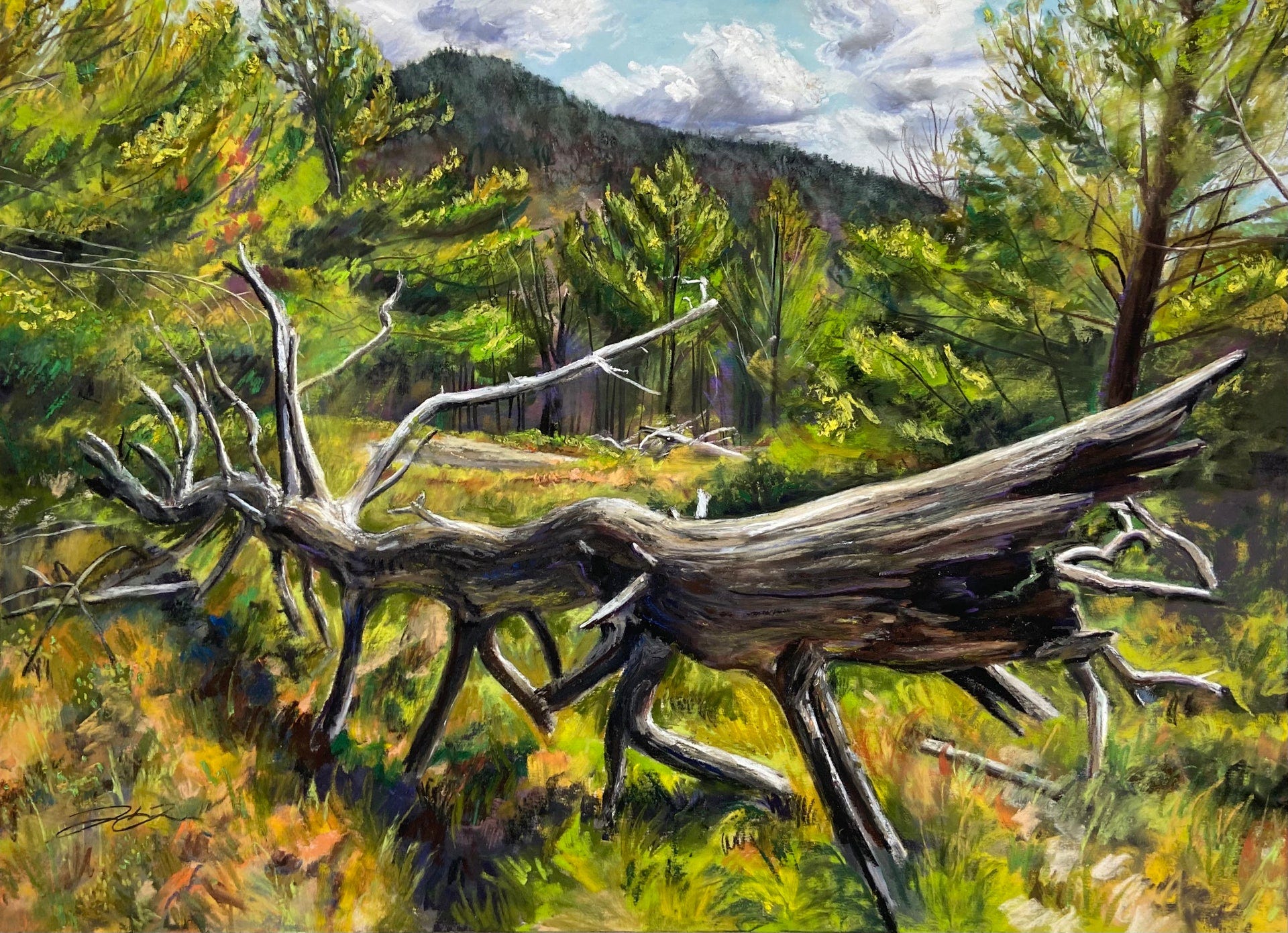
My therapist told me, over and over, to slow down. To let myself heal instead of muscling through it. My astrologer named the season I was in as a period of “convalescence,” a word I resisted then (and still resist now, if I’m honest). I did not want to convalesce. I wanted to get back to being productive. But I learned, mostly against my will, that every time I pushed my body past what it could actually do (which admittedly wasn’t much and that infuriated me) I paid for it later. The bill always came due.
The Gifts That Were Waiting
In slowing down, I started connecting to gifts our culture doesn’t reward.
Namely, anything that isn’t productivity-oriented and goal-focused.
I started to embrace the Both-And that I spent years remembering. I knew this as a child but I had pushed it away in order to please the powers-that-be. So now I write about how the scientist and the mystic aren't opposites competing, they're awareness tuned to different frequencies. I didn't find my gifts inside of or despite my training. I found them because I had slowed down to allow them to emerge as I held the tension of opposites.
My ability to sense what’s beyond the ordinary goes back to childhood, long before the illness. I felt it at fourteen, the morning my father died miles away, and I’ve spent much of my life since learning what to do with a gift I didn’t ask for. My healer gift works the same way. I’ve written about discovering, mid-psychedelic-journey, that I conduct other people’s pain the way a crystal grid conducts energy, and that having the capacity was not the same as having the wisdom to use it well.
Neither of these gifts was new. They had been there the whole time, just unused long enough to atrophy from disuse, the way a muscle does when you stop working it. Or worse, to fire on their own the way the crystal grid did before I learned to ground it.
The illness hadn’t taken something from me. It showed me what I’d ignored and forgotten and gave me a reason to go find it.
The Cost of Misaligned Living
The reason my body had to yell at me is that I was living a misaligned life. On paper, my life was amazing. I had a beautiful home in the mountains of California, owned and ran a successful business and had a loving husband. But I was unhappy and my nervous system was beyond overwhelmed.
“The mass of men lead lives of quiet desperation…. A stereotyped but unconscious despair is concealed even under what are called the games and amusements of mankind. There is no play in them, for this comes after work.”
— Thoreau
I believe that desperation happens when we live a misaligned life. That misalignment creeps up on us slowly as we find new and more insidious ways to avoid discomfort instead of learning from it. Just like the story of the frog in boiling water.
This isn’t only an individual problem, it is a collective one. Western culture learned to exile discomfort the same way it taught us to exile the parts of ourselves that weren't productive. Quiet desperation isn't a personal failing at mass scale, but what an entire culture looks like when it's organized around comfort instead of alignment. Healing the individual and healing the collective are the same process, just at different scales.
We don’t find our way back into alignment passively. We find it by doing some deep work to understand our values and which ones we haven’t been nurturing. When we make daily decisions that prioritize our values (which often comes at the cost of comfort) instead of choosing comfort, we slowly lean back into the gifts we let go dormant.
So I’ll ask you the questions I return to myself, again and again:
What obstacles have shown up in your life that might actually be teachers?
What are they trying to tell you?
What might you be missing by refusing to listen?
If this essay has resonated and you’re ready to seek out the gifts hidden within obstacles, you may enjoy the Practice Guide that accompanies this essay.
From my heart to yours,

New here? Subscribe to receive new essays on healing, trauma, and psychospiritual growth
Coming in 2 weeks: Grief as Transformation
If you recognize your own spiral in this work and you’re wondering whether you need to do this alone — you don’t. I offer psychospiritual coaching for people doing deep healing work. Let’s Talk →
© Linnea Butler 2026
This beautifully captures the difference between discomfort that expands us and suffering that signals a genuine need for rest, safety, or support. The obstacle may become part of the path, but we do not always need to force our way through it. Sometimes the path asks us to pause, listen, change direction, or release a life that no longer fits. Growth is not simply tolerating more pain; it is becoming more discerning about which discomfort serves our values and which repeatedly asks us to abandon ourselves.
Yes. The obstacle is not a punishment. It is an invitation. The discomfort is not a sign that you are on the wrong path. It is the signal that you are at the edge of the container that has been holding you. The contraction is the preparation for the expansion.
What lingers with me is the distinction between avoidance and alignment. Avoidance is the organization of life around comfort. Alignment is the organization of life around truth. The two paths look similar from a distance. The difference is in the trajectory. One shrinks the world. The other expands it.
The gifts that were waiting are not new. They were there the whole time. They just needed the slowing down to be seen.